Intro
The duality: freshness vs opulence — or both?
Through this tasting I tried to showcase some of the possible scenarios, on the one hand elements bringing freshness, on the other hand factors contributing to weight and opulence.
On freshness
- Natural factors : altitude (1), cooler exposures / sites (2), limestone soils (3)
- Vintage impact : cool vintages granting higher acidities or causing under-ripeness (4)
- Agricultural practices: biodynamics (5), precocious harvests (6)
- Cellar practices: whole bunch (7), little extraction (8), concrete / un-oaked aging vessels (9)
On opulence…you may simply inverse the tones !
- Natural factors : flat lands, warm exposures, clay soils
- Vintage impact : warm vintages
- Agricultural practices: late harvests
- Cellar practices: various
A false impression of freshness can be associated with reduction (vegetal – farmyard – fermentation notes). Reduction also shapes the mouth, giving the sensation of verticality. Of course when the wine opens up with oxygen, if there is no inner tension, the wine tends to flatten.
Another subtle astuce in interpreting the wine’s freshness correctly is to know / focus on the type of soil behind the wine. Sandy or granitic soils tend to convey thinner, more vertical shaped wines. The perception of freshness should thus be associated with saline / ionic feeling on the finish…not with acidity.
Another element that can induce a perception of freshness are the balsamic notes (e.g. licorice, mint, euchalyptus). Some can be carried by the choice of the barrel…but also the proximity of euchalyptus trees (that’s the only known case of « contamination » by the neighboring plants 🙂
Last but not least…choosing the blending partners: even in small percentages you can change the shape of the wine !
Let’s get to the tasting !!
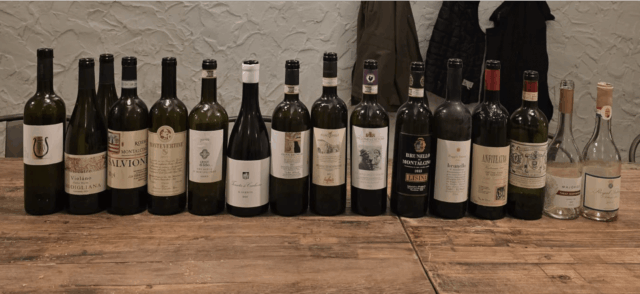
Our tasting
Different kinds of freshness
Wine n.1 – Sangiovese di Romagna – Modigliana « Violano » 2024 – Az.- Agr. Il Teatro // Natural factors
- Our welcome glass offers a pale ruby hue. The nose stretches from the floral spectrum (rose petal, iris) to slightly macerated raspberries.
- The first hints of underbrush start to appear after an energetic shake that dissolves the initial reduction.
- Once the farmyard tones turned into pure crunchy fruit, also the initial CO2 was gone.
- The tannic perception relaxed, the vibrant acidity picked up and « silicious » finish made the mouth watering.
- Altitude freshness and great purity for this wine despite the alarming youth !
Wine n.2 – Rosso di Montalcino 2014 – Az.- Agr. Cerbaiola / Salvioni // Vintage impact
- The second wine opens with a deep ruby hue, mature and inviting.
- On the nose, it delivers a complex tapestry of macerated red berries, seared meat, dried blood, forest floor wrapped in leather, saline notes and juniper — intense, evolved, with a spicy undertone that speaks of time and terroir.
- The palate follows with cassis and meaty depth, high acidity lifting a mid-full body; tannins are present but smoothed by age, lending a polished, almost velvety texture.
- The finish is saline and defined, lingering longer than expected — precise, elegant, and quietly powerful.
Wine n.3 – Toscana IGT « Montevertine » 2018 – Az.- Agr. Montevertine // Natural factors
- The wine presents a bright ruby clarity, youthful and vibrant.
- The nose is fresh, elegant, layered with framboise and strawberry on the stem, floral whispers, and metallic / iodine hints — cool-climate precision meets limestone sapidity.
- The mouth is silky, precise, with fine-grained tannins that evolve rapidly into a lifted, mousse-like texture; the saline thread is present but refined, the tannic fiber slender and chiseled.
- The finish is crisp, focused, clean — a straight line from nose to tail, with great fruit concentration and seamless continuity.
Wine n.4 – Nobile di Montepulciano « Pietra » 2019 – Az.- Agr. Croce di Febo // Agricultural & cellar practices
- First glance to the wine that opens with an youthful ruby robe.
- The nose is brooding — dark fruit, confit cherry, blonde tobacco, mushroom, earth, and pepper — still closed, with malt, red berries, and vanilla peeking through.
- The palate is juicy, high in acidity, with firm, grippy tannins that carry balsamic and volcanic energy; structure is deep, integrated, evolving.
- The finish is calcareous, grippy yet ripe, dense and solid — minty, balsamic notes emerge with air, demanding oxygen to fully reveal its depth.
Wine n.5 – Toscana IGT « Il Guercio » 2022 – Az.- Agr. Carleone // Natural factors + Agricultural & cellar practices
- Wine 5 shines in a rich ruby, vibrant and alive.
- The nose is bright — strawberry, cherry, balsamic, mint, silky cassis, vanilla — natural wine character, with high acidity that feels alive and unforced.
- The mouth is warm, fruit-driven, lively; structure appears light footed but present.
- The finish is clean, crisp, balsamic — natural energy lingers, though not deeply layered, leaving a sense of purity and immediacy.
The blind test
Wine n.6 – Brunello di Montalcino 2017 – Az.- Agr. Le Chiuse di Sotto di Gianni Brunelli // Reduction
- V6 shows a clear ruby, transparent and bright.
- The nose is complex — rose hips, sun-warmed herbs, ferrous notes, no oak; reductive edge, dried apricot, tobacco, leather — fresh but veiled, as if holding back.
- The mouth starts off creamy, silky, filled with juicy fruit. It then tightens up on a grainy-fibrous texture; tannins are grippy but not harsh.
- The finish is calcareous— slightly short, lacking depth; it feels light, unresolved, as if the wine hasn’t yet found its full voice.
Wine n.7 – Brunello di Montalcino 2017 – Az.- Agr. Piancornello // Reduction + Agricultural practices
- V7 pours a light ruby, translucent and delicate.
- The nose is herbal — bitter orange, nettle, smoked vegetal, orange rind — sappy, slightly smoky, with a hint of wildness.
- The mouth evolves with saline notes, grippy yet sappy; hollow at first, then rebounds with salty, sweet-vanilla tannins — civilized, balanced, and surprisingly complete.
- The finish is long, saline, orange-skin bitters, limestone backbone. Coherent, elegant, and quietly confident.
On the opulent side
Wine n.8 – Chianti Classico Gran Selezione « Campo dell’Orzo » 2021 – Az.- Agr. Vallone di Cecione // Vintage impact + cellar practices
- V8 presents a rich ruby, dense and imposing.
- The nose is powerful — nutty, warm, alcoholic, vanilla, oak, date, fig — austere, lacking lift, as if overripe or overworked.
- The mouth is warm, powerful, tannins are exacerbated by the sensation of oxydation; acidity is med + but partially sustained by the volatile acidity.
- The finish is foie gras-like — heavy, collapsing — power overwhelms grace; the wine falls apart, leaving a sense of imbalance.
Wine n.9 – Brunello di Montalcino 2015 – Az.- Agr. Lisini // Vintage impact + cellar practices
- V9 reveals a dense ruby, profound and structured.
- The nose is baroque — spice, truffle, peat, vanilla — rich, deep, international in style, very Brunello.
- The mouth is imposing; dark spice, dense tannic structure, coated by a sustained alcohol; fruit concentration and balsamic freshness.
- The finish is smooth, balanced, long — classic, polished, with a sense of history and depth.
Travelling in time – the flashback
Wine n.10 – Brunello di Montalcino 1996 – Az.- Agr. Poggio Antico
- V10 shows a grenat hue, mature and evolved.
- The nose displays an intense bouquet of dried fruits, meat stock, warm earth, leather, nutty, mushroom, volatile components.
- The mouth is silky, elegant tannins, high acidity; furry texture, mid-body.
- The finish is mellow, soft, lingering on the umami — a wine of age, complexity over freshness, a quiet farewell to fruit.
Wine n.11 – Toscana IGT « Anfiteatro » 1997 – Az.- Agr. Vecchie Terre di Montefili
- V11 opens with a deep ruby, intense and focused.
- The nose is complex and precise — rose hips, smoke, seared meat, resinous elements, camphor.
- The mouth is sappy, with high acidity well-integrated; grippy structured tannins.
- The finish boasts great length, clarity — a wine of definition, tension, and balance.
Wine n.12 – Nobile di Montepulciano « Riserva Grandi Annate » 1993 – Avignonesi
- Finally, V12 pours a dense, dark ruby, opaque and serious.
- The nose offers smoked bark, incense, cedar wood, dried black berries. It shows young but somehow not aligned with the tasting we did so far.
- The presence of some Cabernet Sauvignon alters the achitecture of the Sangiovese. It makes it become stiff, linear — structured.
- The powerful mouth is sustained by mid acidity, firm tannins and a sense of gravity.
- The finish is dense, lingering, but not yet graceful — powerful, not yet polished, a wine still waiting to unfold ?
Conclusions
Sangiovese is no longer the “humble workhorse” but a true mirror of place, climate, and grower’s philosophy.
My aim was to show how wide the spectrum can be and how complex the scenario is…only within Tuscany 🙂
Hope you’re brave enough to keep on trying and widening your experience. Never hesitate to ask for help or support when choosing your bottle and, above all, know what you like / seek for !
Every bottle tells a story. Every sip, a chapter. Every glass, a conversation.
Thank you all and thanks a lot to our host for the warm welcome and generosity !!
To be continued !!