Châteauneuf-du-Pape: 50y retrospective
Entering Châteauneuf
Located in the heart of the southern Rhône Valley, Châteauneuf-du-Pape is one of the world’s most prestigious wine appellations. Historically known as Châteauneuf Calcernier due to its prominent limestone quarries and lime kilns, the region faced a major crisis when the phylloxera epidemic devastated its vineyards in 1877.
The Pillars of the modern appellation
The modern era of the vineyard began during the post-phylloxera replanting efforts of 1878. A critical figure in this revival was Joseph Ducos, owner of Château La Nerthe. As mayor, Ducos officially renamed the villageto Châteauneuf-du-Pape in 1893. Drawing from thorough observations of his estate, he selected and promoted the 13 « identity » grape varieties that came to define the classic blend of the region.
Faced with widespread wine fraud, Baron Pierre Le Roy de Boiseaumarié of Château Fortia spearheaded a producers’ syndicate. Inspired by the legal protections previously granted to Roquefort cheese, this movement established strict local production criteria. These efforts culminated in 1936, when Châteauneuf-du-Pape officially became the first Appellation d’Origine Contrôlée (AOC) in France.
A Mosaic of four main terroirs
The uniqueness of the AOC relies heavily on its diverse geology, which features four distinct terroirs
- The West (Rhône Banks): Characterized by limestone shards and ancient lime quarries. This terroir imparts a distinct verticality and mineral drive to the wines.
- The East and Northwest: Composed of sands and safres (compacted sandy sediments), this zone represents roughly 30% of the territory and is celebrated for producing highly elegant, fine wines.
- The North and Centre: Famous for its alluvial terraces covered in galets roulés. These stones act as thermal regulators by providing moisture retention in the soil and absorbing daytime heat to radiate it back to the vines at night, producing powerful, structured wines.
- The Centre-East: Defined by red iron-rich sandstone (grès rouges), this polyvalent soil yields versatile grapes that offer excellent finesse and serve as a reliable foundation for complex blending.
Know how and major trends over time (1960s to today)
The 1960s & 1970s: The Old-School Era
During this period, Châteauneuf-du-Pape was highly rustic, deeply traditional, and less technologically advanced.
Winemaking was structural, wild, and built for long-term cellaring.
Whole Cluster Dominance: Stem-removing machinery was rare and expensive. Nearly 100% of the grapes were fermented with their stems (whole-cluster fermentation). Stems added high quantities of rustic, herbal, and woody tannins. They also acted as natural cooling sponges in fermentation tanks, which was vital since refrigerated temperature control did not exist in most cellars.
Volatile Fermentations: Without cooling jackets, fermentations routinely spiked above 35°C (95°F). This high heat extracted color, dark fruit flavors, and firm tannins. However, it also regularly caused stuck fermentations or allowed wild yeasts like Brettanomyces to thrive, giving 1960s/70s Ch9 its distinct signature leather, gamey, and furry aroma.
The Power of Raw Concrete: Stainless steel was non-existent in the Southern Rhône. Vinification took place entirely in raw, unlined underground concrete vats.
Aging in old wood: New wood / barriques were never used. Wines were pumped out of concrete and stored for years in large neutral chestnut or old French oak foudres. These ancient casks were used for decades without being replaced, providing oxygen exchange to soften the fierce tannins without imparting any vanilla or toast flavors.
Post-WWII Chemical Agriculture: In the vineyards, this era marked the height of chemical modernization. Following the devastation of post-war economies, systemic chemical fertilizers, synthetic herbicides, and heavy pesticides were widely embraced to secure crop yields and fight rot. The concept of « terroir biology » was largely ignored in favor of efficiency.
The 1980s to 1990s: The technological clean-up
Viticulture: The concept of Lutte Raisonnée (reasoned agriculture) emerged. Growers realized that over-chemicalizing the soil was deadening vine health, leading to a gradual pullback from heavy synthetic schedules.
Oenology: The introduction of mechanical destemmers changed everything. Removing stems resulted in softer, fruitier, and less astringent wines that could be enjoyed much younger. Concurrently, the arrival of stainless steel tanks and glycol temperature-control blankets allowed winemakers to precisely guide fermentations, drastically eliminating bacterial spoilage and off-flavors.
The 2000s to 2010s: The « Parker Era » peak power
Viticulture: Green harvesting (dropping fruit to lower yields) became standard to maximize juice concentration.
Oenology: Driven by international critic preferences (particularly Robert Parker), the region leaned into a hyper-ripe, highly concentrated, and lavish style. Grapes were picked at maximum sugar levels, sending alcohol percentages soaring past 15.5%. Destemming was maximized to achieve a velvety texture, and many modern estates began introducing small, toasted French oak barriques to age their Syrah and Mourvèdre.
The 2020s to Present: the eco-return, climate fight & holistic approach
Viticulture: This is the golden era of Certified Organic and Biodynamic viticulture. Estates work their soils mechanically or with horses to revitalize microbial soil health. Canopy management has changed: instead of leaf-plucking to expose grapes to the sun, growers now leave thick leaves to shade the clusters from the blinding Southern French heat.
Oenology: The pendulum has swung completely back toward freshness and elegance. To combat the naturally high sugars caused by climate change, modern winemakers are deliberately bringing back stems (whole-cluster) to add fresh herbal crunch and lower perceiveable pH. Small oak barriques are widely out of fashion; instead, producers utilize large 600L demi-muids, unlined concrete eggs, and clay amphorae (like Rotem & Saouma) to foster structural purity without wood makeup.
After this large introduction we head towards the tasting 🙂
Enjoy the reading !
Our program
1960s to 1984 vintage notes drawn from Jancis Robinson MW, then from the official website of the region.
The Aperitif: Domaine de la Tour du Bon – Bandol Blanc 2024
The Estate
History & Owner: Located further south on the coast in the Bandol AOC, this stunning estate dates back to the 18th century. It has been brilliantly owned and operated since 1991 by the passionate winemaker Agnès Henry.
Planted Size: 12 hectares sitting on a high, sun-baked clay-limestone plateau near the Mediterranean Sea.
Viticultural Regime: Fully certified Organic and Biodynamic farming practices.
Technical Summary: Unlike the heavy reds of Bandol, this white is a vibrant, mineral-driven coastal masterpiece. It is traditionally a blend of Clairette and Ugni Blanc, sometimes with a small touch of Rolle (Vermentino). The grapes are hand-harvested early in the morning coolness, directly pressed, and fermented using native yeasts in temperature-regulated stainless steel or concrete tanks. The wine is aged on its fine lees for roughly 6 months without malolactic fermentation to retain a crisp, salty, anise-tinged ocean freshness.
Flight n.1
Wine n.1 – Domaine de la Janasse – « Vieilles Vignes » 2008
History & Owner: Founded in 1973 by Aimé Sabon, the domain expanded swiftly when his son Christophe Sabon took over. Christophe and his sister Isabelle Sabon currently run this world-class domain.
Planted Size: Expanded from 15 hectares originally to over 90 hectares today, with about 18 hectares inside Châteauneuf-du-Pape.
Viticultural Regime: Strictly Sustainable / Organic practices (uncertified). They work the soils manually and completely avoid chemical synthetic sprays.
Technical Summary: The Châteauneuf-du-Pape Vieilles Vignes is a spectacular powerhouse made from Grenache vines up to 100 years old, combined with small amounts of Mourvèdre and Syrah. Grapes are 80% destemmed on average. Fermentation lasts 3–4 weeks in concrete. The aging lasts 12 months: 75% matures in traditional concrete tanks, while the remaining 25% (mostly the Syrah/Mourvèdre portion) goes into French oak barrels (one-third new).
2008 Vintage: A true winemaker’s vintage, cool and late, marked by a rainy spring and an unstable summer. Rigorous sorting was absolutely mandatory, but the September Mistral wind saved the harvest, offering wines that are more digestible, less massive, and endowed with higher acid freshness than the decade’s average.
Visual: Deep ruby-garnet hue.
Nose: The nose opens up on dark black olive elements and tapenade, turning toward dry cherry and dried black fig, backed by sweet and spicy melted elements. It shows full maturity now.
Mouth: Light and fleshy at the start, the palate then evolves on toasted and roasted coffee bitters, licorice roots, and stemmy elements.
Finish: Mid-length finish with a chalky perception and definition. Elegant and highly digestible overall.
Wine n.2 – Domaine Saint Préfert / Isabelle Ferrando – « Collection Charles Giraud » 2009
History & Owner: Domaine Saint Préfert was originally established in 1920 by Fernand Serre, who was among the very first winemakers in Châteauneuf-du-Pape to bottle and sell his own wine. In 2002, the talented former banker Isabelle Ferrando purchased the historic estate. She modernized production while honoring the old vines and has recently consolidated her individual labels under the singular family name, Isabelle Ferrando.
Planted Size: The estate covers roughly 22 hectares of prime vineyards situated mostly in the southern, gravelly-sandy Les Serres lieu-dit.
Viticultural Regime: Certified 100% Organic (Agriculture Biologique) and fully biodynamic.
Technical Summary (recent vintages): The Collection Charles Giraud is her flagship luxury cuvée, historically crafted from a blend of roughly 60% Grenache (from vines planted in 1920) and 40% Mourvèdre. Winemaking emphasizes full whole-cluster fermentation (no destemming) in concrete vats using native yeasts. The wine avoids small, standard oak barrels entirely; instead, it is aged exclusively in larger 600-liter French oak demi-muids for up to 18 months, yielding a deep, structurally seamless profile.
2009 Vintage: An extremely solar, hot, and dry year. Ripening was premature and explosive, generating grapes of colossal opulence, rich in sugars and low in acidity, which translated into massive and profoundly warm textures.
Visual: Hazy garnet hue.
Nose: Focused on stewed fruit, dried figs, warm earth, and cherry. It presents a rather powerful profile due to the excessive heat of the year.
Mouth: Driven heavily by licorice and a high alcohol presence, showing an oaky, extracted, and powerful posture. Notes of pollen, sweet cherry, cedar and sandalwood unfold over hints of undergrowth.
Finish: Dominated by licorice and distinctly warm.
Flight n.2 « Here Comes the Sun » …the Beatles 1969
Wine n.3 – Château de Vaudieu 1979
History & Owner: Dating back to 1767, Château de Vaudieu is one of the rare 18th-century châteaux in the appellation. It has been owned by the Bréchet family for over 50 years and is currently managed by Laurent Bréchet.
Planted Size: 70 hectares of contiguous vineyards situated right next to Château Rayas on a highly prized combination of sandy and clay-limestone soils.
Viticultural Regime: Sustainable / HVE (High Environmental Value) certified, utilizing organic practices without full certification.
Technical Summary: (Grapes: Grenache 74% – Syrah 26%). Red grapes are typically 100% destemmed before standard temperature-controlled concrete tank fermentation. The wine is aged for roughly 12 to 18 months, split precisely between older French oak barrels (demi-muids) and traditional concrete vats to ensure pure fruit and structural balance.
1979 Vintage: A highly abundant, good-quality vintage. It offered lovely, fruity, and well-balanced reds that were overshadowed by the legendary 1978.
Visual: Ruby – garnet.
Nose: Positioned between meaty and smoky, showing a fibrous texture. It is not that evolved for its age, simply reflecting another time of winemaking and much higher yields than we are used to today. With air, it reveals sweet dried blueberries, meat, wet leather, and animal notes.
Mouth: Light and thin on the attack, evolving toward notes of foie gras and sweet, bloody elements. Fragile and vertical in structure, it is held by austere tannins that appear somewhat detached from the core matter. Gains weight and consistency as it interacts with oxygen.
Wine n.4 – Michel Fabre – Châteauneuf Réserve Tour St Martin 1964
History & Owner: This refers to a private family selection. The Fabre name is intrinsically tied to old Châteauneuf properties (like Domaine Mont-Redon’s lineage) but Michel F. might be an independent grower.
1964 Vintage: A historically good, sunny year. It yielded warm, rich, and full-bodied wines that were accessible relatively early but tended to age fast.
Visual: Garnet – brown.
Nose: Strongly tertiary, with notes of cola, bergamot, brine, and an oxidized, sherry/port-like character.
Mouth: Surprisingly, the mouth is still consistent. It shows grainy and unprecise tannins, a medium body, and a concentration built by the passage of time.
Finish: Interesting but partially flat overall. The finish resolves on chestnut, with a distinct saline and umami dimension.
Flight n.3 « When experience…and size matter »
Wine n.5 – Domaine Mont-Redon 1983
History & Owner: Known as one of the largest and most iconic classic properties in Châteauneuf-du-Pape, it has been run by the Abeille and Fabre families since 1923. Today, it is directed by Pierre Fabre.
Planted Size: 100 hectares of Châteauneuf-du-Pape AOC vines, planted across the famous galets-roulés plateaus.
Viticultural Regime: Sustainable farming transitioning portions into organic management, utilizing strictly mechanical weeding and respect for biodiversity.
Technical Summary: The traditional red blend relies heavily on Grenache (approx. 60%), rounded out by Syrah and Mourvèdre. Grapes are fully destemmed and undergo a 2-to-3 week maceration. Aging takes place for 12–15 months; half of the juice stays in large concrete vats, while the other half goes into small 228-liter French oak barrels (with only a small fraction being new oak) to preserve freshness.
1983 Vintage: A scorching summer led to accelerated ripening and thick grape skins. This produced brooding, highly tannic, and austere wines that frequently lacked balance.
Visual: Clear garnet with an orange rim.
Nose: Initially shut and heavily concrete-driven, but it evolves to become elegant and airy. Bright elements of bitter orange, cinnamon, and leather emerge with aeration.
Mouth: Fleshy and elegant. The attack is quite evolved, followed by a lovely presence of sweet fruit. The tannins remain firm and smoky.
Finish: Defined with a medium persistence.
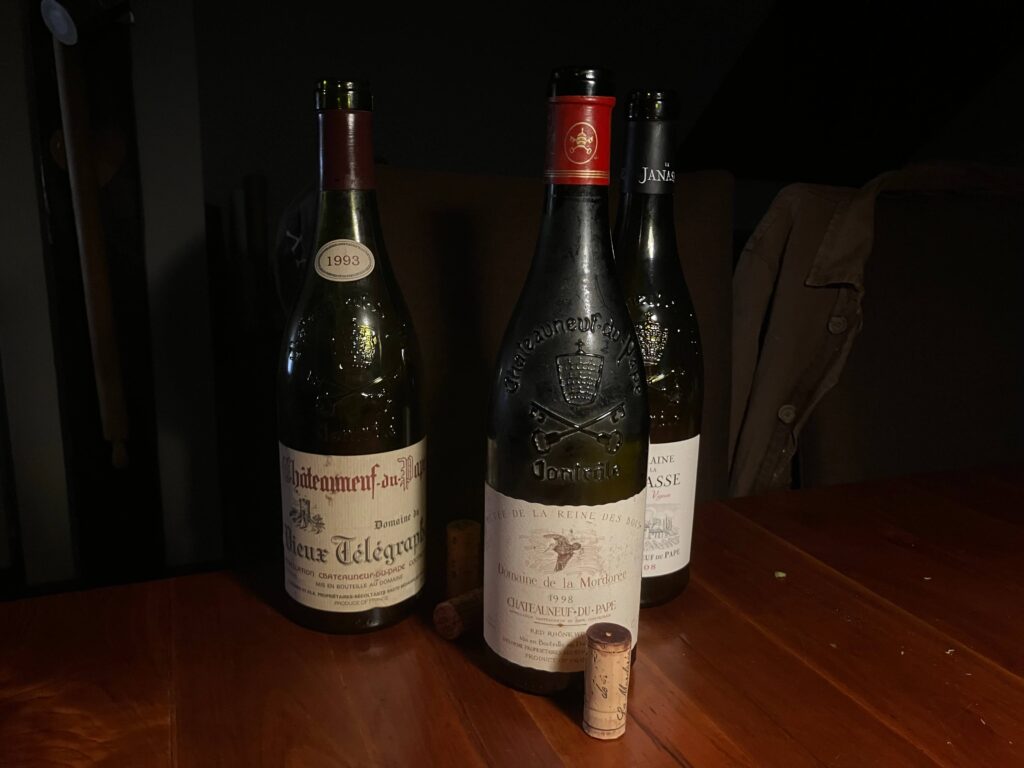
Wine n.6 – Domaine du Vieux Télégraphe 1993
History & Owner: Founded in 1891 by Henri Brunier, the domain is internationally famous for its location on the La Crau plateau. It is passionately operated by the Brunier family (Frédéric and Daniel Brunier).
Planted Size: A total of 147 hectares, of which 100 hectares are in the Châteauneuf-du-Pape AOC area.
Viticultural Regime: Traditional / Reasoned farming (Lutte Raisonnée) with a holistic biodynamic approach. No chemical fertilizers or synthetic herbicides are used; deep plowing is favored.
Technical Summary: The iconic « La Crau » Rouge is a blend of 65% Grenache, 15% Mourvèdre, 15% Syrah, and small percentages of Cinsault. Grapes undergo light crushing and partial destemming, followed by 25–30 days of fermentation in stainless steel and wood. The wine ages for 9–10 months in concrete tanks, followed by another 8–12 months in classic, massive French oak foudres. It is bottled unfiltered.
1993 Vintage: A year marked by very wet harvests and heavy autumn rainfall in the South. A drastic selection of grapes in the vineyard was essential to eliminate rot, favoring elite estates that managed to preserve a beautiful acidity and fresh balances.
Visual: Ruby – garnet hue.
Nose: The absolute quintessence of La Crau. It smells of crinkled hot clay, warm stones, and a deeply earthy Grenache, where the primary fruit has completely faded. Notes of dried ox-blood are complemented by a touch of wildness.
Mouth: The palate is still remarkably juicy, framed by silky, sappy tannins and sweet spice elements. The Mourvèdre brings an excellent, solid backbone to the wine that tends to dominate with oxygenation.
Finish: A perfect bottle evolving on multiple layers of complexity, showing superb elegance with some reserve and potential for a beautiful life ahead.
Flight n.4 « Back to the future »
Wine n.7 – Domaine de l’Or de Line – « Adoption » 2020
History & Owner: Formerly recognized under the name Domaine de la Font du Roi, this estate was renamed Domaine de l’Or de Line by proprietor Gérard Jacumin. The family boasts a deeply rooted lineage of winegrowers in Châteauneuf-du-Pape stretching back over several generations.
Planted Size: A small, carefully managed family domain covering roughly 9 hectares.
Viticultural Regime: Certified Organic (Agriculture Biologique).
Technical Summary: The special cuvée Adoption is a beautifully balanced, modern-classic expression of Châteauneuf-du-Pape. It is a blend crafted primarily from Mourvèdre & Clairette Rose.
2020 Vintage: A vintage characterized by a highly balanced growing cycle, a warm summer without extreme heatwaves, and an early harvest under ideal weather.
Visual: Ruby hue.
Nose: Driven by bramble, pepper, and cinnamon. There is nothing stewed or cooked here; it shows great punch and a delicate floral touch.
Mouth: The palate is held together by a floral element accompanied by some volatile acidity (VA). It shows a somewhat austere mouthfeel, with a dissociated acidity and a slightly warm perception.
Finish: Blue-black berries /floral notes. The wine remains pretty simple and needs oxygen to unwind.
Wine n.8 – Domaine Pierre André 2016
History & Owner: This estate is deeply respected by traditionalists as a quiet pioneer of natural farming in the Southern Rhône. It was lovingly driven to cult status by the late Jacqueline André and her father, Pierre André, who was decades ahead of his time regarding ecological vine balance.
Planted Size: A small, highly focused estate encompassing 16 hectares of old vines (many averaging over 70 to 100 years of age).
Viticultural Regime: One of the absolute historic icons of green farming; it has been farmed without synthetics since 1980 and holds an official Certified Biodynamic (Demeter) status since 1992.
Technical Summary: The traditional red is composed of approximately 80% Grenache, alongside small fractions of Syrah, Mourvèdre, and Cinsault. Grapes are processed with a very minimal amount of destemming. Fermentation takes place naturally using indigenous yeasts in subterranean concrete vats. The aging process is proudly old-school: the wine spends up to 18–20 months resting entirely in neutral, decades-old French oak foudres to preserve pure, bright red-fruit terroir without any vanilla or toast makeup.
2016 Vintage: An anthological and historic vintage for the Southern Rhône Valley. Perfect weather conditions, a hot summer without major hydric stress, and cool nights allowed for ideal phenolic maturation. The wines combine an extraordinary concentration, immensely noble tannins, and remarkable freshness.
Visual: Dark ruby.
Nose: The nose is oriented toward cola and a sweet patina, showing a nearly lactone-driven profile. In a second wave, stems and smoky notes appear.
Mouth: The attack is reductive but releases a very juicy core. The mid-palate is stemmy and robust, sustained by a sweet element.
Finish: Grainy & defined persistence. This is a powerful, tightly wound wine that needs to be revisited after significant oxygenation.
Wine n.9 – Rotem & Saouma – « Châteauneuf-du-Pape Amphora II Rouge » (Pignan) 2013
History & Owner: This modern boutique icon was founded by the husband-and-wife duo Mounir Saouma and Rotem Brakin, famously recognized as the brilliant minds behind the high-end Burgundy micro-négoce Lucien Le Moine. Driven by a desire to bring Burgundian precision, patience, and non-intervention to the Southern Rhône, they bought their first plots in Châteauneuf-du-Pape in 2009.
Planted Size: The estate spans 15 hectares across a unique collection of 9 distinct sub-parcels scattered through all five of the appellation’s villages.
Viticultural Regime: Organic and sustainable farming with minimal plowing to maximize soil microbiological life.
Technical Summary: The Amphora Rouge (Omnia label/variations, here from the Pignan sector) is an extraordinary study in ancient winemaking techniques. It is typically a blend dominated by Grenache and complemented by Mourvèdre and Syrah. The grapes are entirely hand-sorted, left as whole clusters, and placed directly into large clay amphorae (jars). They undergo an exceptionally long maceration and fermentation period of up to 9 to 12 months completely untouched. The wine is pressed off and bottled directly from the clay vessel with no filtration.
2013 Vintage: A late and cool vintage, marked by a particularly cold and rainy spring that caused historical coulure on the Grenache. Yields were drastically reduced, but a sunny late season allowed for the harvest of grapes with superb acid freshness and structures that are less opulent than usual.
Visual: Light ruby with a clear, brilliant hue.
Nose: Slightly reserved and stemmy, showing notes of smoky wood and warm clay. It reveals refined dry raspberry and cranberry, accompanied by minty notes and fresh herbs. It remains dominated by primary aromas, lacking complex tertiary layers for the time being.
Mouth: The acidity is high, well-supported by a protective reduction. The texture is juicy and sappy, built upon long, sandy tannins. The tannic structure shows clear stemmy and concrete-like elements.
Finish: Very fresh, tasting as if it comes from another world and certainly another aesthetic than standard Châteauneuf. Highly acidic, crisp, and digestible, yet filled with mature fruit.
Flight n.5 « When everything goes well »
Wine n.10 – Domaine de Marcoux – « Vieilles Vignes » 2019
History & Owner: Originally founded by the Armenier family, whose roots in Châteauneuf-du-Pape date back to the year 1344. The modern estate was elevated to legendary status by sisters Catherine and Sophie Armenier, who became early champions of biodynamics in the region. Sophie’s son, Vincent Estevenin, now helps steer production.
Planted Size: The domain spans roughly 28 hectares, with its rarest old plots earmarked exclusively for this special bottling.
Viticultural Regime: Certified Biodynamic since the early 1990s; they are recognized as among the very first in the entire appellation to adopt this regime.
Technical Summary: The Vieilles Vignes cuvée is a globally revered collector’s wine made almost entirely from 100% Grenache grown on two specific plots (including the legendary clay-rich soils of Charbonnières), with vines planted between 1900 and 1920. Grapes are entirely destemmed to highlight fruit purity. Fermentation takes place in temperature-controlled concrete vats. The wine is aged for 18 months strictly in concrete vats and large wooden vats, avoiding small oak barrels entirely to preserve the delicate, ethereal floral aromatics of ancient Grenache.
2019 Vintage: A year of historic heatwaves and severe drought. Despite record summer temperatures, biodynamic estates showed remarkable resilience. The harvest yielded grapes of extraordinary phenolic concentration, with low volumes but a magical balance between power and acidity.
Visual: Dark ruby with a brilliant hue.
Nez: Highly concentrated and precise, opening on black cherry and dark fruits.
Mouth: Offers a creamy and velvety texture, showing high density married to immense refinement. Pure and subdued tannins perfectly sustain the elegant length. The inherent power of the vintage is completely tamed and poised here.
Finish: Splendidly long. It is still too young and remains coiled, but it stands as a magnificent subject with a density that just needs time to fully unwind.
Wine n.11 – Domaine de la Mordorée – « Cuvée Reine des Bois » 1998
History & Owner: Established in 1986 by Christophe Delorme, this estate quickly rose to global superstar status for modern, deeply concentrated wines. Following Christophe’s passing, it is beautifully maintained by Madeleine Delorme and her daughter Ambre.
Planted Size: Approximately 60 hectares total, with 17.5 hectares located directly inside Châteauneuf-du-Pape.
Viticultural Regime: Certified Organic and Biodynamic (Demeter).
Technical Summary: The Reine des Bois is a luxury cuvée dominated by old-vine Grenache (up to 60-70 years old), blended with Syrah and Mourvèdre. It undergoes 100% destemming and a long 4-week maceration to extract deep color and body. The wine is aged for 10–14 months; about 30% goes into small French oak barrels and the remainder into concrete tanks.
1998 Vintage: A legendary and absolute monument of a vintage in Châteauneuf-du-Pape, often called perfect. A scorching summer and a persistent northern Mistral wind concentrated the grapes through evaporation, yielding monumental Grenache grapes with extraordinary richness, opulence, and tannic balance.
Visual: Deep garnet.
Nose: Opens on charred meat, hot clay, and dense, sensual tones. The fruit is completely dried and melts beautifully into sweet spice and undergrowth. Earthy, mushroomy elements embellish the bouquet, while saline and iodine notes emerge clearly with oxygenation.
Mouth: Silky at the attack, the velvet texture then accompanies chewy, dense tannins. The finish shows a chalky, slightly resinous touch.
Finish: Great, noble persistence that is still beautifully dominated by the high-class élevage. A perfect bottle.
Flight n.6 « The wrap-up…and the bonus tracks »
Wine n.12 – Henri Boiron – Châteauneuf Réserve Coderey (Lutry Import) 1969
History & Owner: The Boiron family is legendary in Châteauneuf-du-Pape (owners of Clos du Mont-Olivet). « Lutry » indicates a Swiss bottling import selection from that era.
1969 Vintage: A very good, structurally solid year that is often unfairly overlooked. The wines carried firm tannins and an excellent, persistent aromatic finish.
Visual: Garnet to orange rim.
Nose: Displays notes of thyme and rosemary. It is somewhat vague and lacks concentration, revealing methyl elements, gentian roots, and earthy notes, alongside a general lack of intensity in red berry fruit.
Mouth: The texture is grainy, lacking definition maybe but still filled with fruit and juice. The necessary density to carry the structure is still there !
Wine n.13 – Domaine Mont-Redon 1985
1985 Vintage: A blessed and exceptional vintage. Following a historically harsh winter, the summer and a gorgeous September offered perfect ripening conditions, creating flawlessly healthy grapes.
Visual: Shimmering ruby with noble maturity.
Nose: Directly upon being opened and poured, the wine needed to breathe to get rid of the initial « bottle stink. » In a whiff, it opened up beautifully on leather, sweet stone fruit (peach), and meaty, earthy notes. Great purity shows with some oxygenation.
Mouth: Fully mature and finely textured, the wine is smooth and mouth-coating. It feels viscous, rich, and remarkably spherical on the palate. An absolute expression of patined elegance.
Our friendly dinner
Beef salami & potato-beetroot charcuterie from Vallée d’Aoste
Cow cheese with fennel seeds from Val Pellice
Conclusions
This tasting perfectly highlights the extraordinary aging capacity of Châteauneuf-du-Pape while mapping out clear stylistic shifts over the decades. Despite such a clear evolution, the diversity within the appellation from one estate to the next—driven by terroirs, grape blends, and vineyard or cellar practices—is so significant that it is quite difficult to define what Châteauneuf is truly « meant » to taste like. While the breakdown of grape varieties (Grenache 75%, Syrah 11%, Mourvèdre 7%, Cinsaut 2%, etc.) offers a general guideline, the structural rules of the AOP allow for maximum flexibility, enabling each established producer to showcase their unique identity.
The flights were built to compare and contrast these choices, in an attempt to capture how producers navigate two eternal challenges: nature and the market. I chose a non-linear serving order because age mattered only to a certain extent. My real driving force was exploring the shared local culture, traditions, aesthetic benchmarks, and the specific problems and solutions unique to each decade.
All this said, what did the panel prefer? What were the main takeaways?
Out of the 12 participants (myself included), everyone approached each wine with curiosity and an open mind. However, when it came down to personal preferences, the team split into different camps, shifting between
- Finesse vs. power
- Youth vs. maturity (especially regarding the 40+ year-old bottles)
- Classic, traditional Grenache-dominant blends vs. alternative styles
The most reliable gauge of appreciation remained unchanged: which bottles were emptied first once the participants gained free access to the lineup. Astonishingly, it was mostly the oldest, more poised wines. Those displaying sheer power and density remained partially full.
The Grenache-dominant blends—featuring fully integrated oak aging, youthful fruit, or ethereal, mature bouquets—seemed to represent the ideal balance the panel was searching for. On the other hand, the more « creative » samples from the « Back to the Future » flight, which I selected to showcase potential solutions to climate change, certainly provoked reactions but did not quite deliver on the classic Châteauneuf promise.
Thanks again to all the participants for creating such a serene and focused atmosphere. Special thanks to Nicolas and Roberto for their support, and to the collectors who allowed me to purchase these exceptional wines for our tasting. Despite their age, every single bottle was in very good to perfect shape, with no flaws whatsoever. This achievement would not have been possible without the immense love and care dedicated to storing them over all these years.
Because in the end… yes, even wine is a matter of love!
Thank you again,
Michele