Foreword
In a time when the production fell from 30’000 pipes a year to merely a 100 due to the arrival of powdery mildew (1852), the local population was brought to famine and, in the international market, the shortage of Madeira wine was filled with counterfeits…
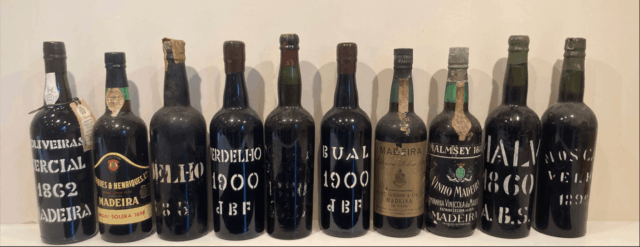
What our tasting has in store for us is a rare line up of “time capsules” perfectly preserved in the cellar of private collectors.
Every ancient bottle we will uncork is a piece of history on its own and a unique experience we’re given to savour.
Hope that the brief introduction that follows will prepare the hearts to welcome such a touching beauty…straight from the past!
Historical focus on the Madera island
A portrait of the market in the past and XIX century
During the Madeira golden age, namely from 1700 to 1825, 65% of the island production went to America, certainly the key market that drove the boom years. During this period wines were drunk young with anything over 3yrs being seen as old.
The beginning of the nineteenth-century was marked by a “boom” in exports also on the European continent, inflated by the Napoleonic Wars, but it didn’t last long. The reopening of the French and Spanish ports, until then closed, and the post war depression rapidly slowed down the developpement.
From the west the instability in North America brought about by the Civil War of 1861 will dramatically affect the exports, from the East, the opening of the Suez Canal in 1869 partially deprived the Madeira island of its strategic position.
In parallel, on the island, all changed in the tough 1850-1900 period with the arrival of phylloxera and diseases. Mildew carried off 90% of the grapes in 1852 and phylloxera continued this devastating work some twenty years later. The majority of the production of Madeira Wine consisted of “Verdelho” and “Tinta Negra”.
Due to these ups and downs, the stocks in the lodges were quite important at this turning point (1850s), the equivalent of some few harvests, and the supply, much larger than the production, could continue for a while. Nonetheless, after this decade, the supply obviously shrunk and the market demand collapsed, re-orienting itself to other beverages. The upside for the modern Madera lovers is that despite the far lower production with respect to the 30k pipas of the golden age, the inventory accumulated unsold and formed the base of the old wines we enjoy today. This means a complete change in style from the 18th century tradition of drinking them young.
XX – XXI centuries
The twentieth-century will be a relatively stable one for Madeira Wine if compared to the previous century. During the first decade of this century and up to the First World War, export markets change and the German market gains enormous projection and a foremost position as the top export market.
This century is equally marked by efforts in terms of regulating Madeira Wine in view of achieving greater quality. It also witnessed the merging of a great number of producing companies, Portuguese and English, thus completely changing the scenario of the entrepreneurial tissue of Madeira Wine producers.
As from the 80s onwards, the tendencies in terms of export markets are delineated and will not undergo significant changes until our days.
The Revolution of 25th April of 1974 in Portugal and its subsequent entry in 1986 into the European Union brought about significant development in the Autonomous Region of Madeira. The reinforcement of pro-quality control, since the foundation of the Madeira Wine Institute in 1979, becomes one of the priorities of governmental policies alongside a significant and healthy development of the viti-vinicultural industry.
Madeira interpretation before 1979
All the well defined technical indications we see today in the PDOs specifications relate to the regulations in force since the birth of the Madeira Wine Institute in 1979. These denominations are a standard of modern era.
The strict control over the goods, as well as commercial goals focused on profits, can no longer allow the follies of the past when everything was more approximate and the results too…
Back to the 19th century ageing in barrels could last more than 50 years. The passage in demijohns was frequent and the wine was kept there for decades or centuries. Many families, the wealthiest in general, produced some Madeira in a confidential way. This could remain indefinitely in their cellar. Sometimes, after 100 or 200 years, the descendants resell a demijohn which is then bottled and perhaps marketed anonymously or under the initials of the family stencilled on the bottles.
Furthermore, bottling on the island started officially only in 1956. It’s therefore quite normal to understand the difficulty in tracking down the history of the lots in such a worldwide market.
Style wise, it’s not unusual also to see a Sercial being sweeter than a Malvasia. The bottle sometimes indicated the word “Madeira” with only its origin: Campanario, Camara de Lobos or once again the name of the ship that carried the precious nectar to its destination.
Nowadays, Madeira wine is produced only by the following eight houses: Madeira Vintners (2013), J. Faria & Filhos (1993), Barbeito (1946), H.M. Borges (1877), Justino’s (1870), D’Oliveira (1859), Henriques & Henriques (1850), Blandy’s (1811) also known as Madeira Wine Company. These producers are mainly found in Funchal and in a few nearby villages, the best known of which is Câmara de Lobos.
Back in the days, there were many more producers than today, each with his own style of course. Some of the most emblematic are Cossart Gordon, Manuel de Sousa Herdeiros, Luiz Gomes, Izidro Gonsalves, Hatsch Mansfield, Leacock’s, Miles Madeiras, Perestrello, Power Drury, Quinta da Conçolaçao, Vega Franca, Western Island Trading…
Several merged / were absorbed by the Madera Wine Company (Blandy family), others disappeared and their priceless wine inventory purchased by competitor firms.
Our commentaries & tasting notes
Aperitif & flight 1 – Sercial
Toughest grape variety to work with, it tends to accumulate very little sugar content. Harvesting at 8.5% potential alcohol is an achievement, 10.5% close to a miracle. It’s determining character is the fierce acidity. The highest among the noble white varieties, second only to Bastardo (red skin) on the M. island.
It spreads mainly in the sector of Seisal (central N coast) and up on the mountain sides, facing the sea, reaching as far as c.a. 700m a.s.l.
Sercial Ribeiro Real 20y – Barbeito
The bottle’s history:
- GRAPE VARIETIES : Sercial & Tinta Negra
- VINEYARDS AND VINIFICATION: Sercial from various quality vineyards located in Jardim da Serra. Tinta Negra from Câmara de Lobos. Grape must from Tinta Negra was obtained through foot treading and Sercial from continuous press.
- RD NOTES: “The Ribeiro Real vineyards from Estreito de Câmara de Lobos spread over the south side of Madeira, fully exposed to the sun at an elevation of about 200 metres above sea level. Great Madeira wines originated in this locality, such as Favila Tinta Negra. We continue to preserve the traditional methods of making and ageing Madeira wine. We selected our best Sercial and blended it with very old Tinta Negra wines from Ribeiro Real. This wine is another homage to the history of Madeira wine.”
- In September 2015, 1259 bottles were filled, all individually numbered.
Rich golden hue with an ochre tinge.
The nose marries the nuttiness and a quince / bitter orange / tropical fruit character, melting into caramel, fine rancio, iodine notes.
In mouth the sweetness level helps making the wine accessible to the otherwise cutting edge acidity. The middle palate is slim, tight, and gives a way to the long saline finish.
Technical specifications
- Alcohol: 19,40 % Vol.
- Baumé: 0,7
- Total sugar: 44 g/l
- Volatile acidity: 1,08
- Total acidity: 7,66
- pH: 3, 39
Sercial 1862 (bottling 2016) – Pereira d’Oliveiras
Note on 1862: small crop but fine quality on Tarrantez, very good on Malvasia
The bottle’s history: Apparently the grapes where harvested in D’Oliveiras family vineyards, as Luis d’Oliveira referred to as being family treasures. They owned very fine vineyard plots in Sao Martinho and remained skilled farmers ever since.
Brownish amber colour, green tinge.
citrus, caramel pur, fruit passion, petrol, slightly burnt caramel, maggi and liquorice, apparent and slightly rustic rancio —> time to move it into demijohn.
The first mouth shows the strength of a recent bottling. The sugar concentration hardly coats the fierce acidity.
Further balsamic freshness is brought by the scent of aromatic herbs. The texture shows quite edgy bitters and an unbalanced alcohol perception. The “old cask character” and burnt caramel show the wine is at the limit of over concentration. The iodine finish is long and saline.
It gains in harmony (acidity and abv) after 3h in the glass.
Sercial Solera 1898 (bottling supposed on 1960s) – Henriques & Henriques
Note on 1898: very fine quality on Sercial & Verdelho
The bottle’s history: Mr Albuquerque had no hints about the reference, apparently not part of the inventory since long time, despite the certainty of no counterfeit. It’s supposed to belong to John Cossart collection, 450 bts drawn from H&H stock in the 1970s and possibly bottled at that time. (in 1960s JNV tended to wax the bottles and this example is posterior to this period)
Light brown-amber hue
Caramelised fruit (despite no caramel added) featuring a earthy – undergrowth character, umami – leather, gently displayed.
The texture is delicate, caressing and, according to some, “gently arranged” Solera blending purpose. High but tamed acidity (long bottling time + quite high sugar content), the iodine notes and a fine rancio underpin the stewed fruit. Umami-savoury finish.
Flight 2 – Verdelho
Verdelho 1885 – Adegas do Torreão
The bottle’s history: This lot / inventory of the house was apparently purchased in 1930s by Justino’s.
This specific batch was bottled in 1970s by Mr Vasco Loje, eminent personality and member of the Madera tasting chamber.
Bright amber hue with green tinge
Extremely refined nose, on “crémeux de fruit” and toffee, leather, subtle petrol notes. Strong umami – developed character converging onto dry mushroom flavours.
Coated first mouth, silky texture and refined bitters. Pineapple-like acidity as a foundation to a precise and concentrated harmonious wine. No doubt one of the great bottles of the evening.
Verdelho 1900 – Joseph B. Fernandez
The bottle’s history: private collection stored on the Madera island and belonging to the homonymous owner. Joseph’s grand son made a living in Trinidad & Tobago and decided to sell the collection constituted by exactly 44 demijohns of 15L each.
The nectar was reconditioned, when possible, and bottled by the Blandy’s lodge in 2014.
The bottling consisted on 32L Sercial, 190L Verdelho, 300L Boal.
Dark amber tones showing great concentration. The clear orange rim, still a remarkable youth.
The nose shows a deviant VA (nail polish – isoamyl acetate) plus a pronounced vinagrinho.
Underneath, burnt orange peel, caramel, sugar cane molasses, toasted coffee powder, dark chocolate.
The mouth is opulent, angular and extremely concentrated, almost lacking shape at this young bottling stage. The overtly concentrated – burnt flavours hinder from a higher assessment.
Flight 3 – Bual
Bual 1880 – PJL
The bottle’s history: supposedly acronym of Dr. Pedro José Lomelino (1864-1930), renowned collector and founder of the ABSL family saga. The Lomelino company bore this name for only one year, 1921, before it became Artur Barros & Sousa Lda, established in 1922. This hypothesis can be supported by the significant amount of ABSL wines in the collection where this bottle was found. The bottle shape and development, furthermore, witness a long bottle ageing, nearing the century.
Clear amber hue with green tinge
The first nose is extremely subtle and integrated, refined rancio and quince gelly, stewed yellow plum, and fruit paste
The attack is pure fine grained velvet and then it gains amplitude. Still fruit coated, the acidity and alcohol are in perfect balance. According to an experienced taster it displays a “Riesling-like minerality” in the finish. The leathery – furry notes at the opening vanished with the decanting (10 days). Simply a seamless wine and a great bottle ! According to RD a wine that received “perfect care during its ageing process”.
Bual 1900 – Joseph B. Fernandez
The bottle’s history: See notes under Verdelho JBF.
Dark mahogany tinge.
The nose at the opening was hard to approach – burnt plastic – tyre character. Immediately decanted, it opened up quickly but remained slightly dusty.
Old cognac bouquet, with petroly notes, gingerbread, tarmac and again burnt rubber.
The high sugar concentration, almost trickle feeling, is lifted by the strong rancio, but still remains dissociated.
It certainly is very / far too young, as it’s sibling Verdelho. We estimate there is room for integration / mellow down with the time in bottle.
Flight 4 – Malvasia
According to Luis Cadamosto writings, the first variety to arrive on the island and almost certainly there already in 1480. It was used for wine making and an apparent trade/import towards the motherland was already recorded.
According to RD the almost disappearance of Malvasia Cândida happened around 1860-70s, with Malvasia de Sao Jorge gaining momentum (the latter having higher natural acidity and faster sugar accumulation).
Malvasia 1880 – CVM Compagnia Vinicola Madeirense
The bottle’se history: the wine was in CVM stock when Ricardo’s father worked there as an accountant. It was almost certainly bottled at the end of the 1950s.
Amber hue with green and brownish reflex.
The nose appeared weak and lacking concentration at the moment of the opening. After 10d decanting it evolved widely on notes of dried red plums, tobacco, wax covered by an acid butter-penicillium patine.
The high sugar content overwhelms the medium acidity, but doesn’t disguise the unbalanced alcohol content, resulting in a quite burning, diluted liquorice finish.
Malvasia Solera 1865 – Cossart & Gordon
Notes on the vintage: small crop, top for Tinta (tinta françesa)
The bottle’s history: no records of this Solera at the estate induces the idea that the wine was shipped in barrel to UK, where the Cossart family had a steady base, and bottled there.
Bright amber colour with greenish hue.
The wine is of extreme precision and finesse, wild strawberry, balsamicŵ – medicinal scents, nutty, leather, smoke and a pure fruit core reminiscent of fig jam.
Liqueur like first mouth, silky touch and pure development through to the finish. The fig jam and the burnt caramel persists, intertwined with saline – umami character. The well integrated bitter notes remain at the end, balancing the sugar content.
The remarkable precision in the oenology and fractional blending make it a sumptuous exemple of Solera.
Malvasia 1860 – ABSL Artur Barros & Sousa Lda
The bottle’s history: the extremely confidential production of the Olim brothers, (25-40hl according to A. Liddell) was made without mécanisation and 100% canteiro method. Despite this, not much can be said about the wines composing their collection as they were made before the company was established (1922). The wine might be a piece of the Dr Lomelino collection constituted in part by wine received as a barter against medical treatments.
Dark mahogany hue
The nose shows a seducing beauty, high flavour concentration on the burnt orange peel, chestnut, honey, iodine, menthol, eucalyptus. The high VA (acetate) constitutes the spine of the wine, both aromatically and in mouth development.
The bitter-tannic tactile perception appears as Robusta coffee powder, black chocolate, burnt caramel. The finish is long, saline with a touch of burnt rubber – caramel.
A great wine, much less “precise” than the previous, but certainly a catalyser of strong emotions.
Moscatel
For certain the most confidential grape variety on the island back then, and totally extinguished today. It was found on the northern shores of the island, namely the sector of Porto Moniz.
Moscatel velha 1900 – ABSL Artur Barros & Sousa Lda
The bottle’s history: See notes above.
Dark and brilliant mahogany hue.
The nose is a showcase of sweet delicatessen, sultana, dark caramel, dried dates, espresso, dark chocolate, still a terpene aromatic…stunning for the venerable age and the oxidative process the wine underwent !
The mouth is a caressing, fine grained liquor. High acidity + rancio to cut through the high sugar concentration, all in perfect balance. The finish is marked by a refreshing balsamic tone, plus a strong umami (vegetable cooking stock) that grants an everlasting sensation.
Key takeaways
The moment we were given to witness was unique and some of these bottles did not appear nor in the historical records of some major tastings held worldwide in the last decades, nor in the records of the wine lodges whose initials are stencilled on the bottles…
Counterfeits ? At all ! Simply missing records, side tracks that these nectars took throughout the centuries, in bottle or most probably in demijohns as a family heritage.
Madera, as an elite product
This situation was at the beginning quite uncomfortable to me…being the MC.
Nonetheless, the more I read and explored the records of previous grand Madera tastings, it appeared to be quite common not to know precisely the life of each bottle !
All this said, it was made clear that approaching wine, cultural product of human civilisation “par excellence”, without a certain know-how/product knowledge is a limit to its full appreciation. Approaching old madeiras without an in depth knowledge of the history of the island and of the trade even more so!
The Madera world, a part for its ordinary crus, was and still is reserved to an elite of consumers. Not only for the price they reach nowadays, but their intrinsic oxidative character, hardly everyone’s cup of tea, and for the difficulty in obtaining the information behind each bottle.
Even for an experienced taster and producer like Ricardo Diogo, it was hard to obtain insights on some of them, for a lot of their history was never written.
For this reason and more, the preparation of this tasting was by far one of the most challenging and loaded with emotion…one year browsing though old texts, travellers notebooks, blogs, family histories, generations whose memory only is made accessible to us thanks to such indestructible wines…nothing else!
Cask and bottle ageing
Certainly a stand out of our tasting was the importance of bottling time for, even if it’s common place to understand that the evolution of the wine is much slower in bottle than in cask, the time in bottle is responsible for a better integration of all the components of the wine.
The old bottlings (30 years or more) were always better integrated, smoother, more harmonious than the recent ones, even at a similar age. The best balance being achieved at 70/80 years in cask and then the rest of their life in glass demijohns / bottle. As longer cask ageing risks to turn the wine into a trickle, far too dense to be appreciated in a glass.
About the tasting notes
I believe it’s necessary to mention that in a day we experienced more than a 1000 years trough these 10 bottles and, despite the technical comments of the engaged participants, none of them had major wine making defaults, none was undrinkable…
I feel comfortable in stating that, if drunk alone, namely with no available means to compare, any of the bottles we opened would be considered very good at least or mind blowing for the best examples !
Our dinner at “Le Portugais”
Thanks to Antonina and Fernando Martins the atmosphere of the evening was warm and intimate, like a family gathering. The initial idea of recreating a Madeira dinner whose recipes were inspired to the xix century became difficult to achieve due to the impossibility of obtaining certain local products. For this, Fernando explored the ancient recipes and adapted them at his best. The effort he made to stress the unicity of such an encounter added an extra culinary and human dimension to it.
Thanks a lot for all the “white nights” he’s been trough, the effort was largely worth !!
Credits
Such an event couldn’t have taken place if it was not for the generosity of some private collectors that allowed me to purchase such nectars they gathered over the decades !
Another important note is for certain to be addressed to Ricardo Diogo, for his participation and shared experience ! It added a legitimate aura and depth to our grand tasting.
Thanks once again, and never enough, to all the participants that took part to the event, for without their trust in the mission of Wine Rose, such moments would be unthinkable to realise.
The next challenge is maturing and I look forward to catching up again soon!
My most sincere regards to you all,
Michele